Stop Making Parents Play Detective
When event details are scattered across texts, emails, and screenshots, families have to reconstruct the truth before every practice. Good clubs give them one place to check.

Part of our series on operational trust: the habits that keep families believing the schedule is current, the messages are relevant, and the system reflects reality.
It’s 7:40 on a Tuesday and a mom is standing in the kitchen with car keys in one hand and a phone in the other. Practice is at 8. Probably. There was a text last week about the pool schedule changing. There’s an email from the club somewhere with a new location. Someone posted a screenshot in the team chat, but it might have been for the other group. The app says one thing, the thread says another.
She’s not checking the schedule anymore. She’s conducting an investigation.
Scattered details make detectives out of families
Every place a detail lives is another place it can be wrong, stale, or contradicted. A club that communicates through texts and emails and chat and screenshots and an app hasn’t given families five conveniences. It’s given them five sources to cross-examine, usually at the worst possible moment, at the last minute, in the car.
The stress isn’t really about the ten minutes of scrolling. It’s the doubt. When sources disagree, a parent can’t fully trust any of them, so every practice comes with a small tax of uncertainty. Ask that parent how the club’s communication is going and you’ll hear the verdict: “It’s chaos. You never know where anything is.”
Trust leaks at the seams
Notice what happened there: the club sent the information, maybe several times, and still lost trust. That’s the trap of communicating by volume. More messages in more channels feels responsible, but every extra copy is a chance for mismatch, and every mismatch teaches families to believe nothing until they’ve checked everything.
The habit: one place holds the answer, messages point to it
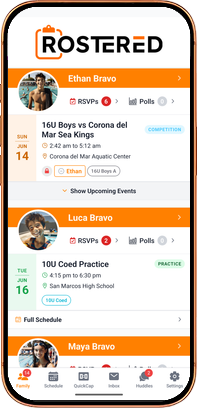
The fix isn’t to communicate less. It’s to separate two jobs that got tangled: the record and the announcement. The record, when and where and who, lives in one canonical place. In a Rostered club, that’s the event itself: the time, the location with a map and the weather, the roster of invited athletes, the RSVPs. The announcement’s job is just to wave people toward it: “Tuesday’s practice moved, check Rostered.”
When messages point to the record instead of restating it, they can’t contradict it. There’s nothing to cross-check, because there’s only one thing to check. And the calendar feed a family subscribed to already caught the change anyway.
The payoff
The kitchen scene gets shorter. Keys, phone, one look at the schedule, gone. No scrolling, no screenshots, no “are you sure?” text to the coach. Families who know where the answer lives check it and believe it, and the club stops paying the trust tax on every practice.
The practical rule: families should never have to compare sources to find out where to be.
Rostered keeps the schedule, the event details, and the messages about them connected in one app, so checking takes seconds. Get your club rostered.